 Future-Ready.net
Mental Models
The Map Is Not the Terrain: Why Smart People Still Get Lost
20260323T1
A map is a miracle. It shrinks a mountain range into something you can hold in your hand. But if you forget that the paper is not the mountain, the thing that helps you navigate can quietly become the reason you get lost.
The hiker with the perfect map
Imagine two hikers setting out at dawn. One has no map at all and is forced to improvise at every fork. The other has a beautiful printed route, complete with contour lines, resting points, and a neat legend. The second hiker feels safer for good reason.
But halfway through the day, the weather changes. A path is washed out. A bridge has collapsed. The confident hiker keeps trusting the old map because it had been so useful for the first half of the journey. The trouble is not that the map was wrong. The trouble is that reality kept moving after the map was made.
Why models work so well until they do not
Every mental model is a compression. It leaves things out in order to be useful. That is not a flaw. It is the whole point. A budget is a model of your financial life. A job title is a model of what someone does. A personality label is a model of behavior. A strategy deck is a model of a business.
The danger appears when a useful simplification gets mistaken for the whole truth. We start managing the map instead of contacting the terrain. We optimize a metric instead of the mission. We defend a framework instead of updating it.
- Frameworks reduce complexity, but they also hide complexity.
- Labels help coordination, but they often flatten nuance.
- Plans create momentum, but they become brittle when conditions change.
How to stay in contact with reality
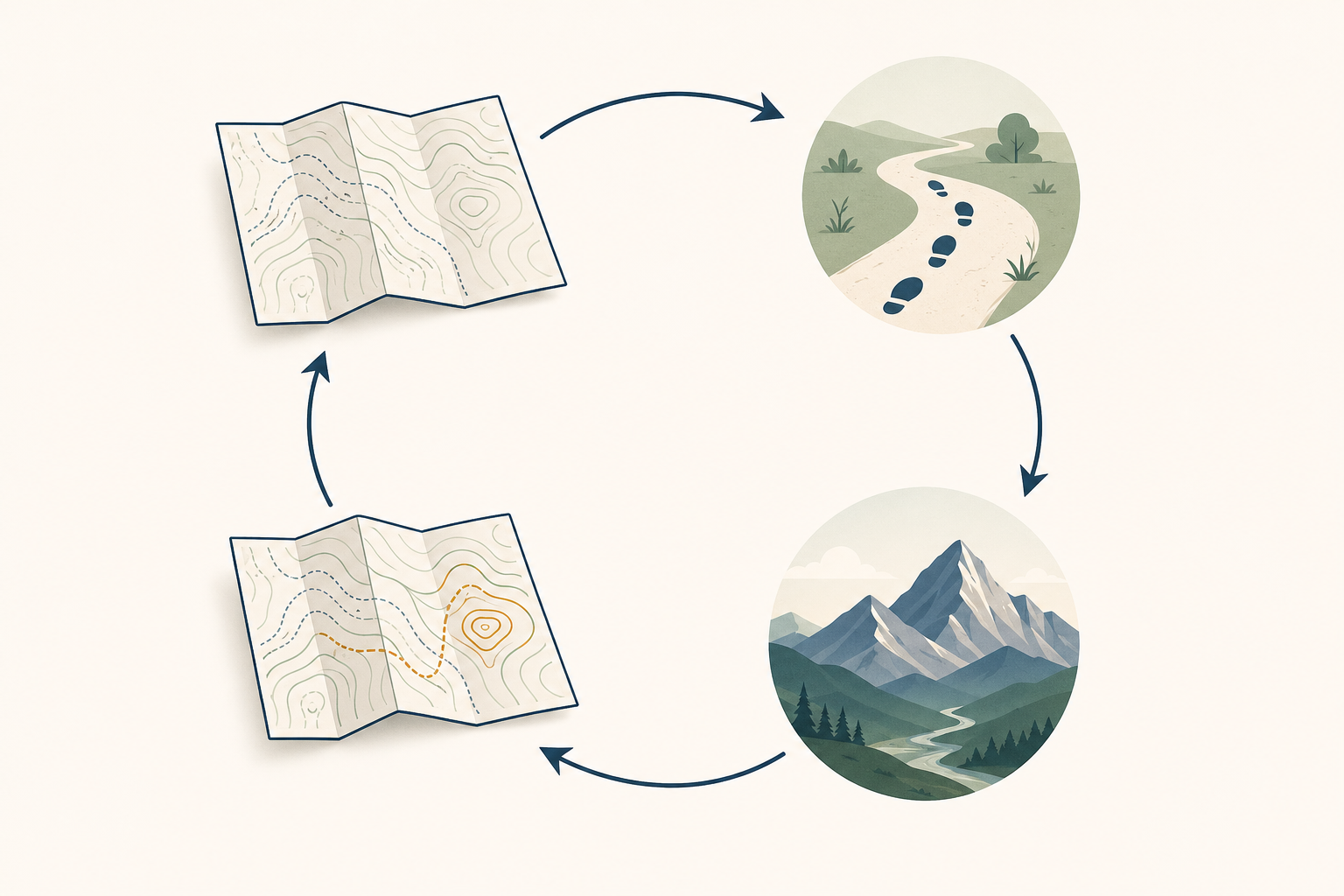
The best thinkers treat models like climbing gear. Valuable, necessary, and never to be confused with the mountain itself. They ask what has changed. They seek disconfirming evidence. They test assumptions before turning them into identity.
This matters even more in the age of AI. Summaries, dashboards, and generated answers are maps of maps. Helpful, yes. But every extra layer of abstraction increases the chance that we begin believing a clean representation over a messy fact.
- Touch the underlying data when possible.
- Use feedback loops that expose you to reality quickly.
- Reward revision instead of punishing it.
- Ask: what would I notice if my model were incomplete?
Try this
- Before making a decision, identify the map you are using.
- Name one thing that map probably leaves out.
- Look for a direct signal from reality before you commit.
Resources
A few strong places to go deeper if this idea resonates.