 Future-Ready.net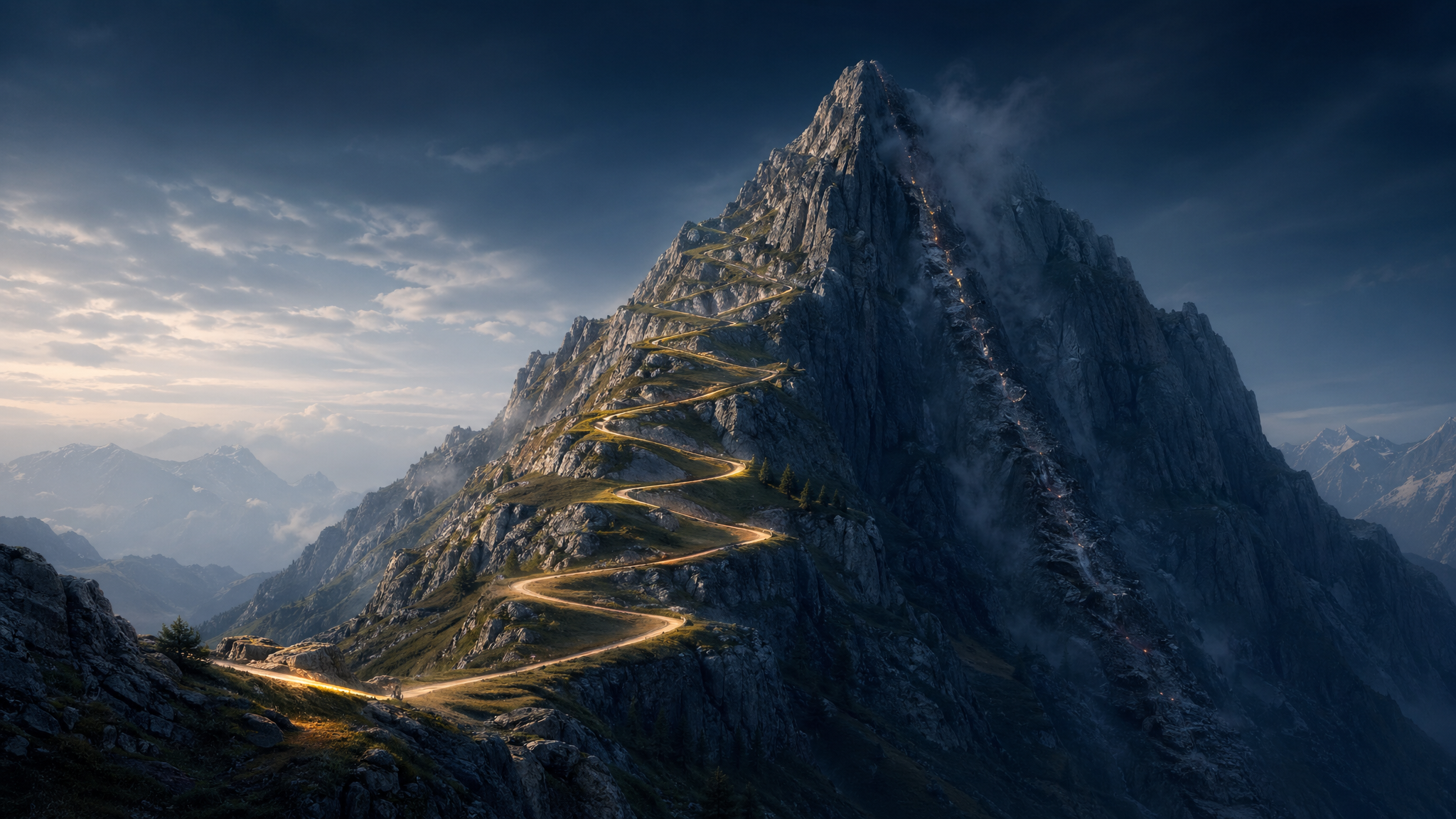
Learning How to Learn
Climbing With Switchbacks: Why Slow Learning Often Wins
20260323T1
If you have ever hiked a mountain, you know the strange logic of switchbacks. The path does not go straight up. It cuts across, doubles back, and seems almost indirect. To the impatient eye, it looks wasteful. To the body climbing it, it is often the only reason the summit remains possible.
The illusion of the straight line
Learners are drawn to methods that feel fast right now. Rereading. Cramming. Watching another explanation immediately after the first one. These create the feeling of fluency. The path looks direct because it removes friction.
But friction is not always the enemy. When a method demands retrieval, spacing, and variation, it can feel slower while building something far more durable.
What switchbacks look like in study
Spacing means returning later instead of overloading now. Interleaving means mixing problem types instead of practicing one in a block. Retrieval means trying to remember before looking. All three introduce effort. All three improve the climb.
This is frustrating because good learning often feels worse than bad learning. Bad learning feels smooth. Good learning often feels like work.
- Immediate ease is not proof of long-term retention.
- Small returns beat heroic marathons.
- Desirable difficulty is still difficulty.
Patience as a modern advantage
In a culture obsessed with acceleration, the ability to tolerate slower-looking learning becomes a competitive edge. People quit methods that work because they do not flatter the ego quickly enough.
Switchbacks are not inefficiency. They are what sustainable ascent looks like when you respect gravity.
Try this
- Replace one rereading session with a retrieval session this week.
- Space your review over several days instead of one burst.
- Judge learning by what remains later, not by what feels easy now.
Resources
A few strong places to go deeper if this idea resonates.